
From Manual Corporate Intelligence to an AI‑Powered Intelligence Operation
How a corporate intelligence firm transformed manual research into a scalable AI‑enabled operation, turning proprietary methodologies into permanent organisational assets.
Business Challenge
The company provides corporate search, due diligence, and investigative research services, gathering and analysing information to help businesses and investors better understand markets, competitors, risks, and opportunities and make more informed decisions.
Each assignment requires researchers to work across multiple online data sources around the world. Information has to be collected, verified, cleaned, organised, consolidated, and turned into highly structured reports.
The work is detailed and complex, but clients expect fast and consistent turnaround. Many services are also relatively standardised and price‑sensitive, making it difficult to absorb increasing labour costs.
Much of the workflow remained highly manual. Researchers spent significant time handling information, checking different sources, tracking records, and preparing reports to established quality standards.
Training was also demanding. New researchers needed time to understand the different data sources, research procedures, verification requirements, and reporting standards before they could handle assignments efficiently.
As project volume increased, more work often meant more people. This increased delivery costs and limited the company’s ability to scale profitably.
The organisation wanted to answer three key questions:
Automate Complex Collection
How can we automate complex information collection, verification, and report preparation across multiple global sources?
Deliver Faster Without More Headcount
How can we deliver more assignments faster and with consistent quality without increasing headcount at the same rate?
Reusable Organisational Assets
How can we turn accumulated company information and completed reports into reusable organisational assets?
The challenge was not simply reducing manual effort. It was building a faster, more standardised, and more scalable corporate intelligence operation.
Strategic Orientation
Workforce, Workflow & Automation (勢) → New Business & Value Innovation (變)
Understanding the Workflow
We began by working with the company’s experts to understand the workflow, methodology, data sources, and quality standards behind each corporate intelligence product.
These proven ways of working were then transformed into AI‑enabled workflows, allowing AI to handle much of the repetitive information gathering, data preparation, and report production.
AI‑Enabled Workflows with Traceability
A key part of the design was traceability. Throughout the AI‑enabled workflow, detailed audit trails were captured to show how information was sourced, processed, verified, and used in the final report.
This allowed human experts to review not only the final output, but also the evidence and key steps behind it.
Human experts therefore remained an essential part of the last mile. They could quickly verify critical findings, identify exceptions, and provide final sign‑off with a clear evidence trail, ensuring every report met the organisation’s quality standards and the specific requirements of its clients.
Two Reusable Foundations
At the same time, we established two reusable foundations:
AI‑Ready Data Foundation
Multiple global data sources were organised into a structured, AI‑ready data foundation that could be reused across assignments.
Corporate Intelligence Knowledge Base
Completed cases and reports were captured into a growing corporate intelligence knowledge base, making every new assignment stronger than the last.
Together, these capabilities allowed the organisation to deliver more work with greater speed and consistency, while turning every completed assignment into an asset that could support future projects.
The Transformation
The organisation evolved from a labour‑intensive corporate intelligence operation into a more scalable AI‑enabled intelligence business.
Today, AI handles much of the repetitive information gathering, data preparation, and report production, while human experts remain responsible for validation and final quality assurance. This allows the same team to process more assignments, shorten turnaround time, and maintain consistent quality without increasing headcount at the same rate.
More importantly, the transformation created two growing organisational assets: an AI‑ready data foundation and a reusable corporate intelligence knowledge base of completed cases and reports.
Every new assignment strengthens these assets. Previous cases can be searched and reused more easily, reducing the effort required for future work and making the organisation increasingly efficient over time.
New Business & Value Innovation
The transformation also created the foundation for New Business & Value Innovation (變).
By analysing recurring client requests, report types, and patterns across accumulated cases, the company can identify services that can be standardised, packaged, and offered as new intelligence products.
Instead of relying only on manpower‑intensive, project‑by‑project assignments, the organisation can begin to build more repeatable and scalable services such as:
- Standardised company checks
- Ongoing monitoring
- Risk screening
- Specialised due diligence products
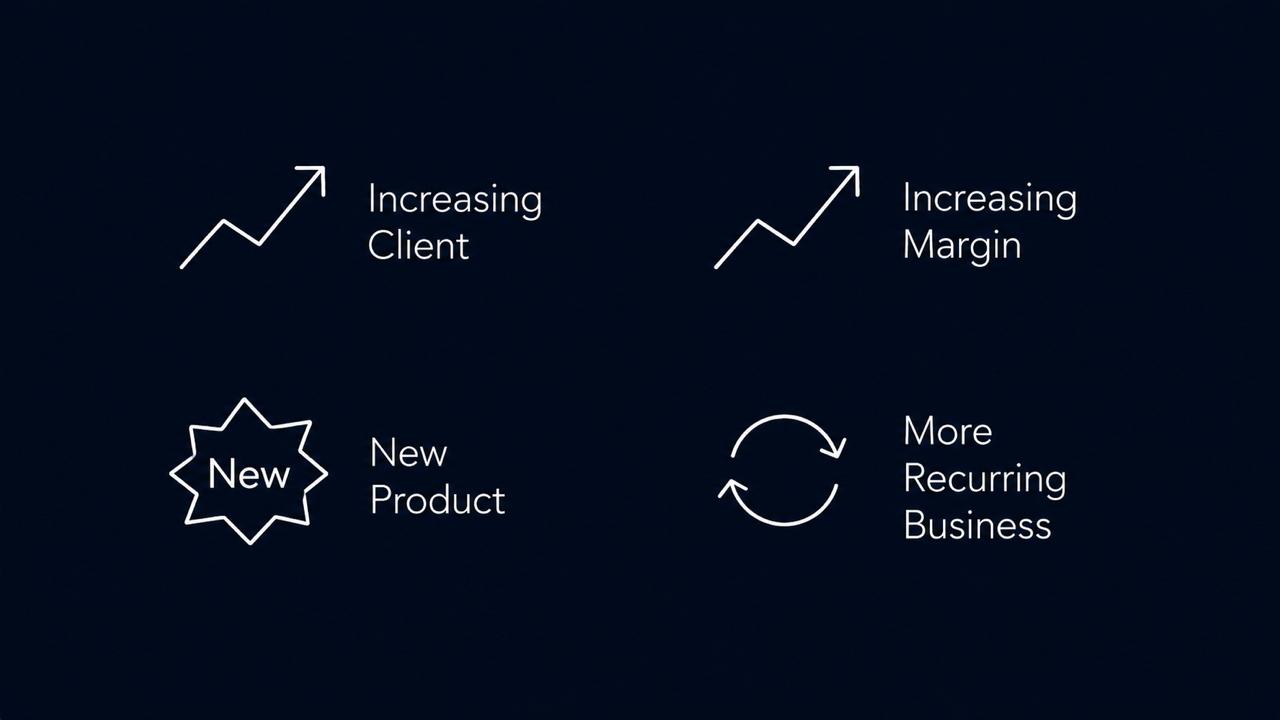
The result is not simply lower operating effort. It is a business that can serve more clients, improve margins, and turn its accumulated intelligence into new products and recurring business opportunities.